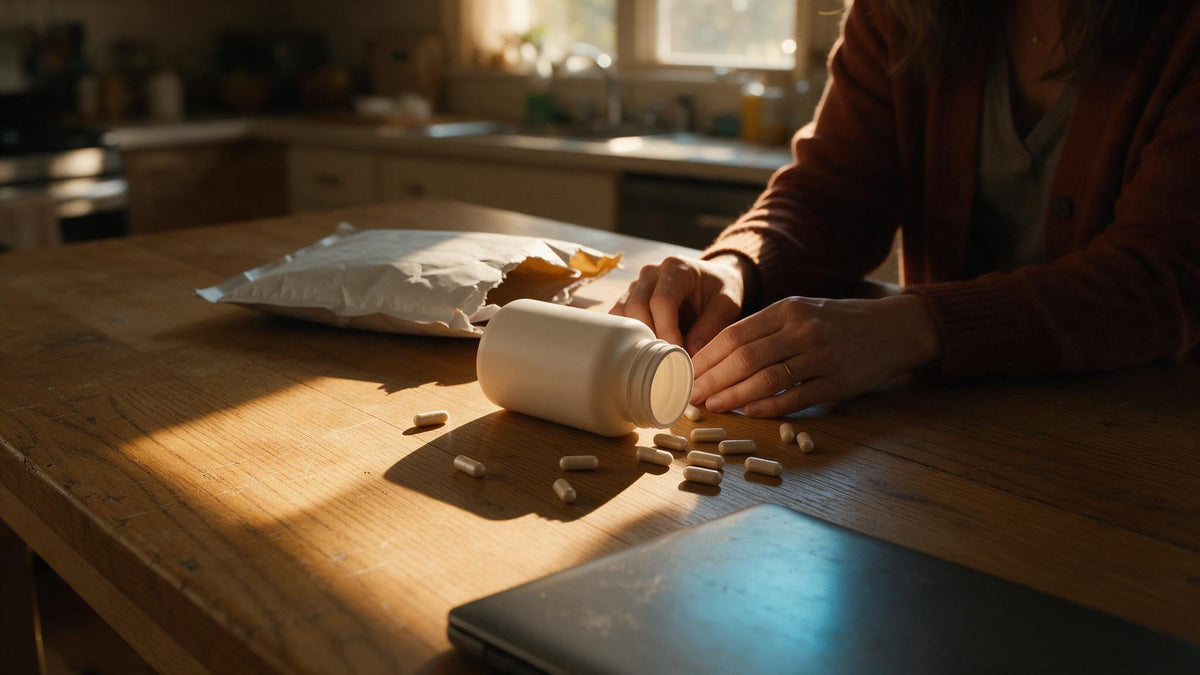
No product sold as an ivermectin supplement has FDA approval behind it, because ivermectin is not a dietary ingredient and cannot lawfully be one. The FDA-approved human ivermectin products are a small, specific set: according to the FDA Orange Book product data file dated 11 September 2026, there are 15 distinct human ivermectin applications covering 17 product rows, and only three dosage forms appear across all of them — oral tablet, topical cream and topical lotion. If you want the full breakdown of which forms are actually approved, that page lists each one with its application number.
Everything else marketed under the ivermectin name — capsules sold as supplements, mail-order kits, loose powders, compounded suppositories, marketplace listings — sits outside that approved set. This page explains what "no approval" means in legal terms, how to verify a product yourself in about two minutes, and what US agencies have documented about unapproved and counterfeit ivermectin. It names no sellers and endorses none.
Key takeaways
- Under the drug-exclusion provision of the federal definition of a dietary supplement, an article approved as a new drug generally cannot be sold as a supplement; ivermectin was approved as a new molecular entity on 22 November 1996 under NDA 050742.
- Per the FDA Orange Book data file of 11 September 2026, the only approved human ivermectin dosage forms are oral tablet (3 mg and 6 mg, prescription), 1% topical cream (prescription) and 0.5% topical lotion (over the counter, head lice only).
- There is no FDA-approved human ivermectin powder, capsule, suppository, oral liquid or injection.
- FDA has issued warning letters treating ivermectin website sales as the introduction of misbranded and unapproved new drugs, and its 5 April 2024 consumer update states it has not authorized or approved ivermectin for preventing or treating COVID-19 in humans or animals.
- Animal ivermectin products — pastes, drenches, pour-ons, injectables — are labeled for use in animals only and are not approved for people.
Drug versus dietary supplement: why the distinction decides everything here
A dietary supplement is regulated as a category of food and needs no premarket approval for safety and effectiveness. A drug does. Which box a product falls into is not decided by the seller's wording — it is decided by statute.
The definition of a dietary supplement at 21 U.S.C. 321(ff) contains a drug-exclusion clause: an article approved as a new drug is excluded from the supplement definition unless it was marketed as a dietary supplement or as a food before that approval. FDA describes this same provision in its new dietary ingredient guidance for industry. Ivermectin was approved as a new drug well before any supplement marketing: FDA's Drugs@FDA record for NDA 050742 (STROMECTOL) shows an original approval of 22 November 1996 as a Type 1 New Molecular Entity.
The practical consequence: a capsule or tincture that actually contains ivermectin is not a supplement that happens to be strong. It is an unapproved new drug, and 21 U.S.C. 355(a) bars introducing a new drug into interstate commerce without an effective approved application.
What a product sold as an ivermectin supplement is legally claiming
A seller who labels an ivermectin product as a supplement is implicitly claiming two things at once, and they cannot both be true. First, that the product is a food-category article needing no approval. Second — usually in the marketing copy rather than on the label — that it does something to a disease. A disease claim on a food-category product is one of the acts prohibited by 21 U.S.C. 331, which bars introducing an adulterated or misbranded article into interstate commerce.
A related trap appears in FDA's own listing database. DailyMed carries ivermectin 0.5% topical listings filed as OTC monograph drugs rather than under any approved application, from firms including Guangxi Keyun E-commerce, Yunqi Cosmetics, Shenzhen Xuyan Technology, Shenzhen Zhenshangzekai Technology and Guangzhou Yusong Fine Chemicls; one Shenzhen Zhenshangzekai listing cites OTC monograph M031 with a marketing date of 10 December 2025. Ivermectin is not a monograph pediculicide ingredient: 21 CFR 358.610 permits only pyrethrum extract combined with piperonyl butoxide. Appearing in a federal listing database is not the same as being approved.
Kits and protocols sold online: what is in them and what approval they lack
Kits typically bundle tablets of uncertain origin with unrelated vitamins or minerals and a printed protocol. No such bundle has an FDA approval, because approval attaches to a specific product, strength and indication — not to a regimen.
FDA has acted against this trade. Its warning letter of 16 March 2023 (MARCS-CMS 650184) told one website that its site "introduces into interstate commerce misbranded and unapproved new drugs." FDA's consumer update on ivermectin, content current as of 5 April 2024, states that "The FDA has not authorized or approved ivermectin for use in preventing or treating COVID-19 in humans or animals."
The same FDA page acknowledges that, with few exceptions, health care professionals may choose to prescribe an approved human drug for an unapproved use when they judge it medically appropriate for an individual patient. That is a statement about licensed prescribers and the approved human products — not about kits. FDA's advice on the same page is that a prescription should be filled "through a legitimate source such as a pharmacy."
Powders, suppositories and other forms with no approved product
Counting from the FDA Orange Book product file dated 11 September 2026, the dosage-form field across all 17 human ivermectin rows takes only three values. Everything else is absent.
| Form | Listed in the FDA Orange Book, data file of 11 September 2026? | Marketing status in that file |
|---|---|---|
| Oral tablet, 3 mg and 6 mg | Yes — 8 applications, 10 rows | 9 rows prescription, 1 discontinued; no OTC row |
| Topical cream, 1% | Yes — NDA 206255 plus three ANDAs | Prescription |
| Topical lotion, 0.5% | Yes — NDA 202736 and ANDA 210720 | Over the counter, for head lice |
| Powder or bulk substance for human use | No row | — |
| Suppository | No row | — |
| Human injection, oral liquid, capsule | No row | — |
Powdered ivermectin sold to consumers is an unapproved article whose identity, purity and strength no agency has reviewed. For suppositories and other custom forms, the compounding route is not an open door: 21 U.S.C. 353a(a) conditions the compounding exemptions on the product being compounded for an identified individual patient based on a valid prescription order. Our page on compounded preparations covers what that does and does not allow. And on the veterinary side, 21 CFR 530.13(a) states plainly that nothing in that part permits compounding from bulk drugs.
Marketplace listings: what platform policies say and what still appears
Searches for ivermectin on eBay are governed by the platform's own rules. eBay's published policy states that prescription drugs, or products containing prescription-strength medication, are not allowed, while over-the-counter medications, herbal products, vitamins and veterinary medicines must follow listing guidelines. Policies of this kind are enforced by detection, so listings framed as supplements, "research" chemicals or animal products can appear before removal.
Two things follow for a reader. A platform's willingness to host a listing is not a regulatory status. And a listing that survives because it is described as an animal product remains an animal product: FDA's letter to stakeholders of 10 April 2020 states that "People should never take animal drugs, as the FDA has only evaluated their safety and effectiveness in the particular animal species for which they are labeled."
How to check any product against the Orange Book and the Green Book in two minutes
Human products — the Orange Book
Open FDA's Orange Book search, whose footer stated "Current through September 2026" when we checked it. Search the active ingredient, then read three fields: dosage form, strength and marketing status (RX, OTC or DISCN). If the form in your hand is not one of the listed forms, there is no approved product to compare it against. Tablet strengths other than 3 mg or 6 mg do not appear in that file at all.
Animal products — the Green Book
FDA's Green Book active-ingredient report lists 46 distinct approved animal drug applications with ivermectin as an active ingredient. A Green Book entry confirms approval for the named animal species only. For example, the Farnam ivermectin paste label shows approval under ANADA 200-390 and reads "For Oral Use in Horses Only"; it is an animal drug, labeled for animal use only, and is not approved for people.
What the FDA's warning letters and import alerts in this area document
Warning letters in this area are consistent in their theory: the product is an unapproved new drug and the site's claims misbrand it. That was the finding in the 16 March 2023 letter cited above. On imports, FDA's Import Alert 66-41 covers detention without physical examination of unapproved new drugs promoted in the United States, and explains that new drugs may not be introduced into interstate commerce without an approved application in effect, unless they are nonprescription drugs lawfully marketed under an OTC monograph. Mail-order purchases from overseas sellers fall squarely inside that framework.
We could not verify from a primary source any national pharmacy chain's or farm-supply retailer's own published policy on ivermectin sales, so this page makes no claim about them.
Counterfeits: what the agencies have found and what to look for
US Customs and Border Protection has reported seizing misbranded ivermectin tablets arriving in international mail, in packages declared as other goods, and turning them over to FDA's Office of Criminal Investigations — see CBP's Chicago field office release. Laboratory work outside the US points the same way: a peer-reviewed analysis published in Drug Testing and Analysis in 2024, "Substandard and falsified ivermectin tablets obtained for self-medication during the COVID-19 pandemic as a source of potential harm", reported that the samples examined did not meet the quality criteria set for medicinal products.
Practical checks are limited but real. Approved US tablets are dispensed by pharmacies against a prescription; the STROMECTOL label's HOW SUPPLIED section describes white, round, flat, bevel-edged 3 mg tablets coded MSD on one side and 32 on the other. Blister strips in foreign-language packaging, strengths that do not exist in the Orange Book, or an "Rx only" symbol on something sold without a prescription are all signals worth taking seriously.
Why this page names no sellers
Naming a website or marketplace shop would function as a referral, including to sellers shipping prescription medicine without a prescription. That is a practice FDA treats as unlawful distribution of unapproved and misbranded drugs, as the warning letter above shows. It would also date badly: the sites change names faster than any reference page can be revised. We describe categories and verification methods instead. If you are weighing lawful routes, our page on buying online lawfully sets out what a legitimate pharmacy transaction looks like.
What to do if you already bought something
- Do not take an animal-labeled product. Animal ivermectin pastes, drenches, pour-ons and injectables are approved for the animal species named on their labels only and are not approved for human use.
- Keep the packaging and any invoice. It helps a clinician and it is what FDA asks for in an adverse-event report through MedWatch.
- If someone has taken an unapproved product and feels unwell, seek medical care. The STROMECTOL label's WARNINGS section describes neurotoxicity — including altered consciousness, confusion, disorientation and death — reported with ivermectin use, including in patients without onchocerciasis.
- If you have a prescription need, take it to a licensed pharmacy. FDA's consumer update advises filling an ivermectin prescription "through a legitimate source such as a pharmacy."
- Do not attempt to return or resell it. Reselling a prescription drug or an unapproved product moves the legal problem onto you.
Frequently asked questions
Is ivermectin a supplement?
No. It is a drug molecule approved as a new drug in the United States on 22 November 1996 under NDA 050742, and the drug-exclusion clause at 21 U.S.C. 321(ff) excludes an approved new drug from the dietary supplement definition unless it was marketed as a supplement or food before approval.
Is there any legal way to buy powdered ivermectin for personal use?
No approved human ivermectin powder exists in the Orange Book data file of 11 September 2026. FDA's personal importation approach is a policy rather than a regulation, and we could not verify it from any CFR or US Code provision, so this page makes no claim about it.
Are ivermectin suppositories approved for anything?
No suppository appears among the 17 human ivermectin product rows in that Orange Book file. A compounded suppository would require a valid prescription for an identified individual patient under 21 U.S.C. 353a(a).
Do any states let me buy ivermectin without a prescription?
Seven states have an ivermectin access law on our verified state-law tracker, each checked against that state's own legislative record: Arkansas (Act 396, Ark. Code Ann. § 20-7-147; no in-force date recorded), Idaho (S 1211, Idaho Code § 37-135, in force 14 April 2025), Iowa (HF 2676, Iowa Code § 126.24, in force 1 July 2026), Louisiana (Act 464, La. R.S. 37:1218.3, in force 20 June 2025), Missouri (SB 878, Mo. Rev. Stat. § 338.208, in force 28 August 2026), Tennessee (Public Chapter 908, Tenn. Code Ann. § 63-10-224, in force 22 April 2022) and Texas (HB 25, Tex. Health & Safety Code ch. 446, in force 4 December 2025). Two of the seven — Arkansas and Idaho — put nobody at the counter; the other five route the decision through a pharmacist or a pharmacy. North Dakota is often counted alongside these seven, but it does not belong there: its law (N.D.C.C. § 43-15-42.4, in force 15 November 2021) is a shield law, not an access law. It protects the prescriber or pharmacist from discipline or liability and creates no new route for a patient, so a prescription is still required in North Dakota. None of these laws makes an unapproved kit, powder or supplement lawful — they concern approved human products dispensed by pharmacies.
Are approved tablets expensive compared with a kit?
We do not publish retail prices, because no primary source verifies them. For scale only, CMS's National Average Drug Acquisition Cost — what pharmacies pay, not what patients pay — was $1.99423 per 3 mg ivermectin tablet effective 23 September 2026.
Is ivermectin approved for scabies in the US?
No US human ivermectin label carries an approved scabies indication. The STROMECTOL prescribing information revised September 2024 lists exactly two: strongyloidiasis of the intestinal tract and onchocerciasis.
Sources
- 21 U.S.C. 321 — Definitions (dietary supplement, subsection (ff)), Cornell LII
- FDA, New Dietary Ingredients in Dietary Supplements — Background for Industry
- 21 U.S.C. 355(a), govinfo
- 21 U.S.C. 331 — Prohibited acts, govinfo
- 21 U.S.C. 353a — Pharmacy compounding, govinfo
- 21 CFR Part 358, Subpart G — Pediculicide Drug Products, § 358.610, eCFR
- 21 CFR 530.13 — Veterinary compounding, eCFR
- FDA Orange Book search (current through September 2026)
- FDA Orange Book data files (products.txt, 11 September 2026)
- Drugs@FDA, NDA 050742 (STROMECTOL) approval history
- DailyMed, STROMECTOL (ivermectin) tablet label, revised September 2024
- DailyMed, Lice Treatment Dedicated (ivermectin) lotion listing, OTC Monograph M031
- DailyMed, Ivermectin Paste (Farnam), ANADA 200-390 — animal use only
- FDA Green Book, Section 2.0 Active Ingredients report
- FDA Warning Letter, MARCS-CMS 650184, 16 March 2023
- FDA Import Alert 66-41
- FDA Consumer Update, "Ivermectin and COVID-19" (content current as of 5 April 2024)
- FDA, Ivermectin Intended for Animals: Letter to Stakeholders, 10 April 2020
- eBay, Illegal drugs and drug paraphernalia policy
- U.S. Customs and Border Protection, Chicago field office media release on seized ivermectin tablets
- Vanhee et al., Drug Testing and Analysis (2024), substandard and falsified ivermectin tablets
- CMS, NADAC 2026 dataset (record effective 23 September 2026)
- State legislative sources for the seven access laws: Arkansas Act 396; Idaho S 1211 board memo; Iowa HF 2676; Louisiana Act 464; Missouri Rev. Stat. § 338.208; Tennessee Public Chapter 908; Texas HB 25. Legislative source for the North Dakota shield law, which is a protection law rather than an access law: North Dakota HB 1514.