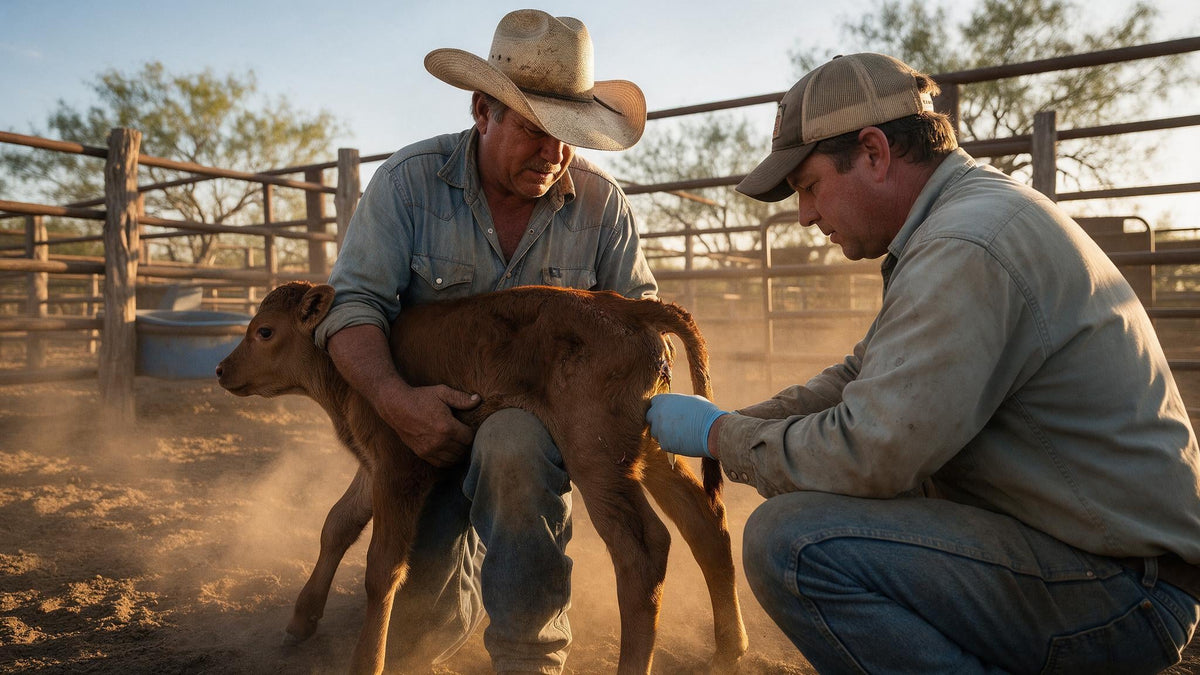
As of 28 September 2026, no ivermectin product carries full FDA approval for New World screwworm. What exists instead is a set of temporary authorizations: an Emergency Use Authorization for injectable ivermectin in cattle, another for an oral ivermectin solution in horses, and a third for a generic cattle injectable — all for prevention only, all animal drugs, and none of them a treatment for a wound that is already infested. If you want to see how narrow that is in practice, it helps to first understand which labels carry which claims under ordinary approval, because none of the long-standing approved ivermectin labels mentions screwworm at all.
Everything described here is an animal formulation, labeled for animal use only, and not approved for people. FDA states that animal ivermectin products are different formulations than those approved for humans and that their safety in humans is not known. The screwworm authorizations changed nothing about that.
Key takeaways
- FDA's Center for Veterinary Medicine stated in its Dear Veterinarian Letter of 5 June 2026 that no animal drug has received full FDA approval for New World screwworm (NWS) myiasis; products reach the market through conditional approval or Emergency Use Authorization.
- FDA reported that, as of 3 September 2026, it had issued 15 Emergency Use Authorizations and three conditional approvals for animal drugs against NWS.
- The ivermectin authorizations are prevention-only. The Ivomec cattle EUA (006689, 5 February 2026) and the equine EUA (006681, 15 July 2026) both cover prevention triggered by specific events, not treatment of an existing infestation.
- Extra-label use is limited to fully approved drugs, so it does not extend to conditionally approved products or EUA products, per FDA's 5 June 2026 letter.
- USDA APHIS confirmed the first US detection in a Texas calf on 3 June 2026 and, on 31 August 2026, approved the release of two infested zones in Texas.
What New World screwworm is and why it is in the news again
New World screwworm is the fly Cochliomyia hominivorax, whose larvae feed on the living tissue of warm-blooded animals. In its 24 October 2025 press announcement, FDA described NWS as infesting livestock, pets, wildlife and, in rare cases, humans, causing severe tissue damage and sometimes death, and noted that although it was eradicated from North and Central America decades ago it has progressed north since 2022.
The reason it is back in the news is a domestic detection. FDA's Dear Veterinarian Letter of 5 June 2026 was written to follow up USDA's announcement that NWS had been detected in Texas near the US–Mexico border.
The USDA APHIS record: detections, response actions and the sterile fly programme
USDA's Animal and Plant Health Inspection Service is the agency of record for detections and movement controls; FDA's role is limited to the drugs. APHIS announced on 3 June 2026 that it had confirmed NWS in a calf in Zavala County, Texas, with larvae in the umbilical area. On 8 June 2026 APHIS confirmed two further cases, a calf in La Salle County and a dog in Andrews County, and described a unified response led with the Texas Animal Health Commission. On 31 August 2026 APHIS approved the release of two Texas infested zones, with the concurrence of the Texas State Veterinarian and TAHC.
The eradication tool is the sterile insect technique: sterile male flies are released so that matings produce no offspring. USDA announced the completion of a sterile fly dispersal facility at Moore Air Base in Edinburg, Texas on 9 February 2026, and on 9 March 2026 announced a construction contract for a sterile fly production facility at the same site. Case counts move; APHIS's own detections dashboard, not a news summary, is the record to check.
What an on-label screwworm claim looks like, and which ivermectin products carry one
An on-label claim is language FDA has reviewed and permitted in an approved indication. Conditionally approved doramectin is the clearest example: the DailyMed label for Dectomax-CA1 states it is indicated for prevention and treatment of infestations caused by larvae of Cochliomyia hominivorax, and prevention of reinfestation for 21 days (the label prints "21 day"). It was conditionally approved on 30 September 2025 under application number 141-616 — conditional means pending a full demonstration of effectiveness. Fluralaner topical solution followed: Exzolt Cattle-CA1, conditionally approved under application number 141-617 and announced by FDA on 4 December 2025, is indicated for prevention and treatment of NWS myiasis and for cattle fever tick in beef cattle 2 months of age and older and replacement dairy heifers under 20 months, and is available by prescription only.
No ivermectin product is in that position. The approved ivermectin labels predate the outbreak by decades and say nothing about screwworm: IVOMEC Injection (NADA 128-409, 10 mg/mL) is indicated in cattle for gastrointestinal roundworms, lungworms, cattle grubs, sucking lice and mange mites, and the 1.87% equine paste ZIMECTERIN (NADA 134-314) covers strongyles, ascarids, bots, lungworms, threadworms, summer sores and Onchocerca dermatitis. The ivermectin screwworm claims all sit under EUAs.
| Product | Regulatory status | Screwworm scope on the FDA document | Dispensing |
|---|---|---|---|
| Ivomec (ivermectin) injection, cattle | EUA 006689, 5 February 2026 (approved product, NADA 128-409, for other uses) | Prevention only, cattle | Over the counter |
| Bimectin (ivermectin) injection, cattle | EUA 006729, 27 August 2026 (ANADA 200-447 for other uses) | Prevention only, cattle | Over the counter |
| Ivermectin Liquid for Horses (oral solution) | EUA 006681, 15 July 2026; product not FDA-approved for any indication | Short-term prevention only, horses | Prescription |
| Dectomax / Dectomax-CA1 (doramectin) | EUA 006700, 19 May 2026; Dectomax-CA1 conditionally approved 141-616 | Prevention and treatment in dairy cattle; prevention only in horses ≥1 year, swine, non-lactating sheep, deer | Over the counter |
| Exzolt Cattle-CA1 (fluralaner topical) | Conditional approval 141-617 | Prevention and treatment, beef cattle ≥2 months and replacement dairy heifers <20 months | Prescription |
Where ivermectin fits and where it does not: prevention versus wound treatment
The cattle authorization is event-triggered. FDA's fact sheet for the Ivomec EUA (Rev. 02/2026) covers prevention of NWS myiasis when the product is administered within 24 hours of birth, at castration, or at the appearance of a wound, in cattle other than female dairy cattle producing milk for human consumption and calves to be processed for veal. Cattle must not be slaughtered for human consumption within 35 days of treatment, and no milk discard time has been established. Those slaughter withdrawal intervals are residue-depletion periods set per product and species — not half-lives, and not a measure of how long protection lasts.
The horse authorization is narrower still. FDA's press announcement of 15 July 2026 states that the EUA covers only short-term prevention, not treatment, and that if a wound is already infested, or an infestation develops after administration, a veterinarian should be contacted about treatment options. FDA's CVM director stated that the window of prevention lasts no more than 24 hours, so the product must be used alongside bandaging, repellents and other fly control. The dose on the veterinarian fact sheet is 91 mcg per pound (200 mcg/kg) — 1 mL per 110 lb, 10 mL for an 1100 lb horse. It is for horses only; FDA warns that use in other species may cause severe adverse reactions, including fatalities in dogs, and that it must not be used in horses intended for human consumption.
How strong is the evidence?
Weaker than many readers assume, and FDA says so. The same fact sheet states there is no clinical data in horses supporting effectiveness for prevention of NWS myiasis; the basis is ivermectin injection studies in cattle plus a bioequivalence study involving 20 horses. Twelve Argentine and Brazilian studies from the 1990s reported prevention in over 97% of exposed calves, but a 2019 Brazilian rainy-season study found 28.5% effectiveness on Day 3 and 13.5% on Day 7. An EUA rests on a "may be effective" standard, not the evidence standard for approval.
Nothing here transfers to other ivermectin dose forms. The approved topical pour-on products for cattle (IVOMEC Pour-On, NADA 140-841, 5 mg/mL at 1 mL per 22 lb, 48-day withdrawal) carry no screwworm claim, nor does the 0.08% sheep drench (NADA 131-392, 11-day withdrawal) used in sheep and goats — and no FDA-approved ivermectin product lists goats as an approved species at all.
Approved wound treatments and why they are a separate product category
Treating an infested wound is a different job from stopping larvae from establishing, and FDA has handled it with different products. The doramectin EUA 006700, issued to Zoetis on 19 May 2026, covers prevention and treatment in dairy cattle, but prevention only in horses one year and older, swine, non-lactating sheep and deer; route differs by species, with intramuscular injection only in swine and horses. Its limitations of authorized use set a 35-day slaughter withdrawal for dairy cattle, sheep and deer, 24 days for swine, and a milk discard of 468 hours (19.5 days) after treatment. For small animals, FDA's first-ever animal drug EUA was for Credelio (lotilaner) chewable tablets for treating NWS infestations in dogs, on 24 October 2025. FDA has continued to add authorizations since the 3 September 2026 count, including Capstar (nitenpyram) tablets and a revised EUA for generic nitenpyram for prevention and treatment in dogs and cats, so any count should be read as a snapshot.
One category does not exist: medicated feed. FDA states that no medicated feeds have been approved for prevention or treatment of NWS myiasis for any species, and that no medicated feeds containing ivermectin or doramectin are approved for any indication for cattle or wildlife in the US — a point worth noting before extrapolating from methods used for wildlife treated for mange.
Extra-label use in this context, and the veterinarian's role
Extra-label use is a veterinary framework, not a consumer one. Under 21 CFR 530.1, Part 530 applies to extralabel use in an animal by or on the lawful order of a licensed veterinarian within a valid veterinarian-client-patient relationship. Section 530.11 lists four uses that are not permitted, including use by a lay person except under the supervision of a licensed veterinarian, and — without any exception — extralabel use in or on an animal feed. In food animals, 21 CFR 530.20(a)(2) requires the veterinarian to make a careful diagnosis, establish a substantially extended withdrawal period supported by appropriate scientific information, maintain identification of treated animals and assure no illegal residues occur; records must be kept for 2 years or longer if other law requires it. Ivermectin does not appear on the prohibited-drug list at 21 CFR 530.41(a).
The decisive limit for screwworm is narrower. FDA's 5 June 2026 letter states that extralabel use is limited to drugs with a full FDA approval, so it does not include conditional approvals, index listed products, or products with an EUA. A veterinarian cannot lawfully stretch Dectomax-CA1 or an EUA ivermectin product to a species or use outside its authorization. FDA also warns in the same letter that some countries dealing with NWS have seen antiparasitic resistance develop over time, and urges veterinarians to use authorized or conditionally approved products as indicated and only when medically necessary.
Reporting obligations: who a producer must call, and how fast
Immediately, and to the animal health authorities rather than to FDA. CDC's situation summary, last updated 11 August 2026, states that veterinarians should report any suspicious animal cases immediately to their state animal health official and APHIS office, and that healthcare providers suspecting a human infestation should report immediately to their local or state health department. APHIS's Foreign Animal Disease Investigation Guide for NWS directs that when a suspect case is reported by an owner, veterinarian or another agency, the State Animal Health Official or the USDA Area Veterinarian in Charge is contacted immediately, a foreign animal disease investigation is initiated if warranted, and the National Veterinary Services Laboratories communicates results back to the state official.
In Texas, the Texas Animal Health Commission instructs producers to report all suspected and confirmed cases immediately, with livestock and companion animal reports going to TAHC and wildlife reports to Texas Parks and Wildlife. Use the agency's current contact page rather than a number copied from a third-party article.
Import, movement and inspection rules currently in force
This is the fastest-moving part of the response, and it is set by USDA and state animal health officials — not by the drug authorizations. We are not stating a current port or import status here: it has changed repeatedly, and we could not verify a current position from a primary USDA source at the time of writing on 28 September 2026. APHIS's own announcements and its NWS pages are the authoritative record.
What is verifiable is the mechanism. APHIS establishes infested zones around confirmed detections, with movement controls inside them, and lifts them only with state concurrence — which is what the 31 August 2026 release of two Texas zones represents, following concurrence from the Texas State Veterinarian and TAHC. Separately, the drug authorizations have no geographic expiry tied to zones: FDA states that each NWS EUA remains effective until it is revoked or the HHS Secretary terminates the underlying declaration, which HHS Secretary Robert F. Kennedy, Jr. signed on 18 August 2025 and which was published at 90 FR 40609.
Pets and people: what the public health agencies have said
On human risk, FDA stated on 24 October 2025 that the risk to human health from NWS in the United States remains very low, and that NWS infests humans only in rare cases. CDC's page for clinicians, updated 11 August 2026, sets the reporting path described above rather than any drug recommendation.
The HHS declaration of 18 August 2025 is, on its own terms, a declaration that circumstances justify emergency use of animal drugs to treat or prevent NWS myiasis in animals; it states that it enables FDA to issue EUAs for animal drugs. Human ivermectin tablets remain prescription products in the US, and FDA approved five generic human ivermectin applications between 22 January 2025 and 7 April 2026 (ANDAs 215922, 218805, 216863, 216808 and 218509). Several states have changed how human ivermectin is obtained at a pharmacy — among them Idaho (Idaho Code § 37-135, in force 14 April 2025), Louisiana (Act 464, La. R.S. 37:1218.3, in force 20 June 2025), Texas (HB 25, Tex. Health & Safety Code ch. 446, in force 4 December 2025), Iowa (HF 2676, Iowa Code § 126.24, in force 1 July 2026) and Missouri (Mo. Rev. Stat. § 338.208, in force 28 August 2026) — but none of those laws concerns screwworm or animal products.
For pets, the ivermectin cautions are specific and severe. The regulation for the sheep drench at 21 CFR 520.1195(e)(2)(iii) states the product is for use in sheep only and that use in other species may cause severe adverse reactions, including fatalities in dogs; 21 CFR 522.1192(d)(2) requires the same precaution on injectable ivermectin labeling. Approved canine ivermectin heartworm products are dosed in micrograms — a minimum of 6.0 mcg/kg monthly under 21 CFR 520.1193 — and are restricted by federal law to use by or on the order of a licensed veterinarian. A livestock syringe is not a scaled-up dog dose, and none of these products is approved for people.
Frequently asked questions
Has FDA approved ivermectin for New World screwworm?
No. FDA stated on 5 June 2026 that no animal drug has received full FDA approval for NWS myiasis. The ivermectin screwworm claims exist under Emergency Use Authorizations, and FDA reported 15 EUAs plus three conditional approvals as of 3 September 2026.
Can injectable cattle ivermectin be used on a horse, dog or goat for screwworm?
The authorizations do not permit it, and extra-label use cannot fill the gap because it is limited to fully approved drugs. The IVOMEC Injection label states the product was developed for cattle, swine, reindeer and American bison only and warns of fatalities in dogs.
Does the equine EUA product treat an infested wound?
No. FDA states the EUA authorizes short-term prevention only, and directs owners to contact a veterinarian about treatment options if a wound is already infested or an infestation develops after administration.
What is the slaughter withdrawal after using the cattle ivermectin EUA?
FDA's fact sheet states cattle must not be slaughtered for human consumption within 35 days of treatment, and because no milk discard time has been established the product is not for female dairy cattle producing milk for human consumption.
Could a person use animal ivermectin because of screwworm?
These are animal formulations, labeled for animal use only and not approved for people. FDA states animal ivermectin products are different formulations from those approved for humans, that their safety in humans is not known, and that medications intended for animals should never be used on people. Suspected human infestations should go to a clinician and to the local or state health department.
Sources
- FDA CVM, Dear Veterinarian Letter: Use of FDA-Authorized Animal Drugs Against New World Screwworm Myiasis (5 June 2026)
- FDA, Animal Drugs for New World Screwworm (content current as of 3 September 2026)
- FDA, Fact Sheet: EUA of Ivomec (ivermectin) Injection for NWS (Rev. 02/2026)
- FDA, FOI Summary, EUA 006729, Bimectin (ivermectin) injectable solution (27 August 2026)
- FDA press announcement, EUA for short-term prevention of NWS in horses (15 July 2026)
- FDA, Fact Sheet for Veterinarians: EUA of Ivermectin Liquid for Horses (Rev. 07/15/2026)
- FDA, Fact Sheet: EUA of Dectomax/Dectomax-CA1 (doramectin) for NWS — Dairy Cattle, Swine, Sheep, and Deer (Rev. 05/19/2026)
- FDA press announcement, conditional approval of a topical cattle drug for NWS and cattle fever tick (4 December 2025)
- FDA press announcement, EUA for Credelio (lotilaner) for dogs (24 October 2025)
- FDA press announcement, EUA for Capstar (nitenpyram) and revised generic nitenpyram EUA for dogs and cats
- FDA Consumer Update, Ivermectin and COVID-19 (content current as of 5 April 2024)
- DailyMed, DECTOMAX / DECTOMAX-CA1 (doramectin injection) label
- DailyMed, IVOMEC (ivermectin) Injection for Cattle and Swine label
- DailyMed, IVOMEC Pour-On (ivermectin topical solution) label
- DailyMed, ZIMECTERIN (ivermectin paste) 1.87% label
- eCFR, 21 CFR 520.1195 Ivermectin liquid
- eCFR, 21 CFR 520.1193 Ivermectin tablets and chewables
- eCFR, 21 CFR 522.1192 Ivermectin injection
- eCFR, 21 CFR 530.1 Scope (extralabel use)
- eCFR, 21 CFR 530.11 Limitations
- eCFR, 21 CFR 530.20 Conditions for permitted extralabel use in food-producing animals
- eCFR, 21 CFR 530.41 Drugs prohibited for extralabel use in food-producing animals
- eCFR, 21 CFR 530.5 Records
- HHS, Declaration of Emergency Pursuant to the FD&C Act for New World Screwworm, 90 FR 40609 (18 August 2025)
- USDA APHIS, USDA Confirms Presence of New World Screwworm in the United States (3 June 2026)
- USDA APHIS, USDA Confirms Two Additional Cases of New World Screwworm (8 June 2026)
- USDA APHIS, APHIS Approves Release of New World Screwworm Infested Zones in Texas (31 August 2026)
- USDA, Completion of Sterile Fly Dispersal Facility in Texas (9 February 2026)
- USDA APHIS, USDA and USACE Advance NWS Preparedness with New Production Facility Contract (9 March 2026)
- USDA APHIS, Foreign Animal Disease Investigation Guide: New World Screwworm
- CDC, New World Screwworm Outbreak situation summary (updated 11 August 2026)
- Texas Animal Health Commission, New World Screwworms
- FDA CDER, ANDA 215922 approval letter, ivermectin tablets USP (22 January 2025)
- Idaho Division of Occupational and Professional Licenses, Board of Pharmacy memo on S 1211 (Idaho Code § 37-135)
- Louisiana Legislature, SB 19 (2025 RS), Act 464
- Texas Legislature Online, HB 25 (89th Legislature, 2nd Called Session)
- Iowa Legislature, HF 2676 bill history
- Missouri Revisor of Statutes, § 338.208